Common badminton mistakes hold players back more than a lack of skill. Many
beginner and intermediate players struggle with control and consistency because of repeated technical
and tactical errors.
If you want to improve your badminton performance, you first need to identify
what is going wrong on the court. You can practise for hours and still lose points because of these
repeated mistakes. These badminton mistakes usually happen in three areas: technique, positioning, and
decision-making.
Most players focus on learning new shots, but real improvement often starts with fixing what goes wrong
in basic play. Poor grip control, weak footwork, incorrect court positioning, and rushed shots can
quickly cost points. These habits reduce confidence and limit progress over time, even if you practise
regularly.
This blog breaks down the most common badminton mistakes and explains how you can correct them.
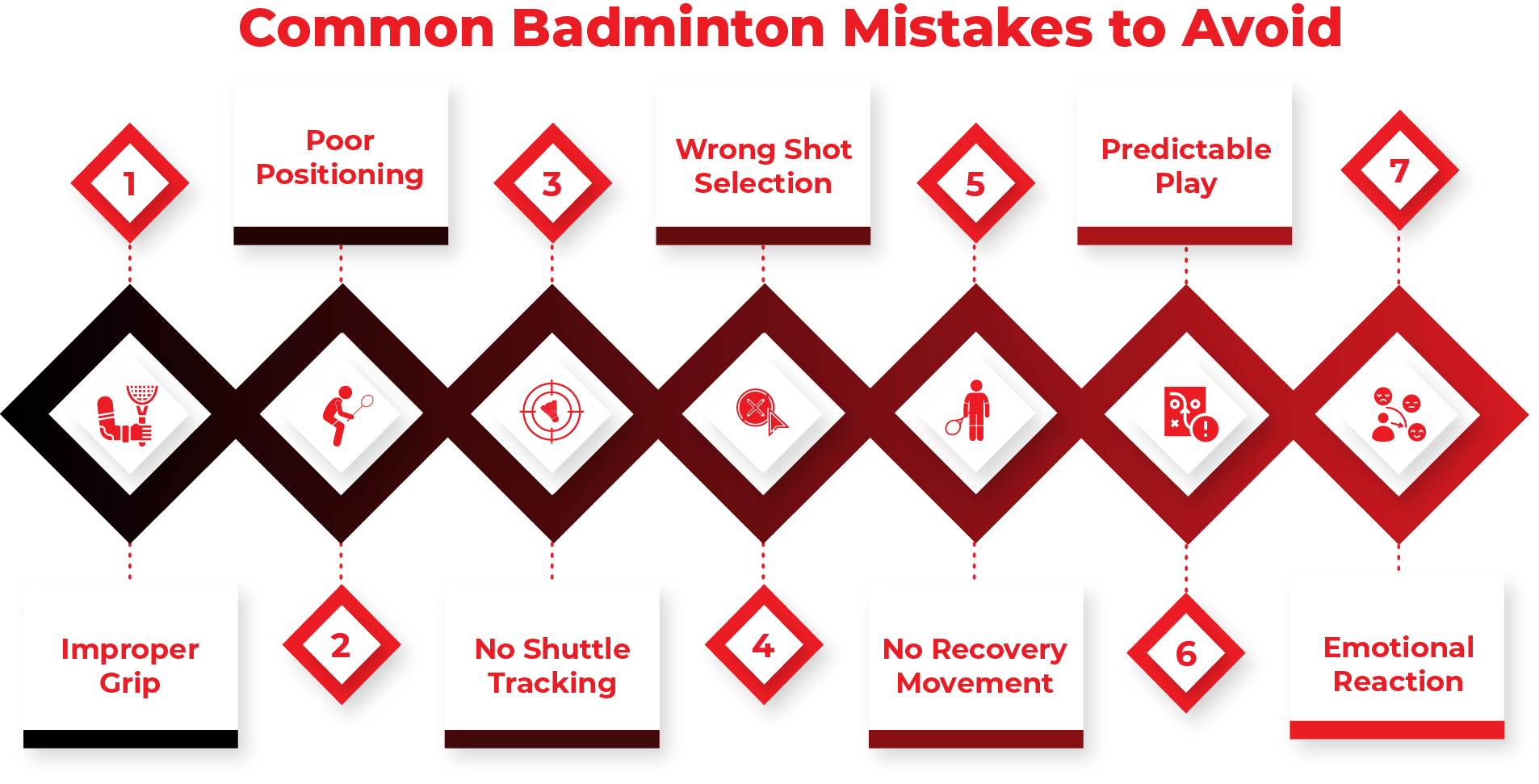
Mistake 1: Improper Grip
A correct grip is the foundation of every badminton shot. When players hold
the racket incorrectly, it limits their control, power, shot variety, and comfort. Here is how this
mistake shows up and why it matters:
- Holding the Racket Too Tightly: A tight grip reduces wrist flexibility, making it harder to
generate power and control. Beginners often squeeze the racket, which leads to stiff movements and
poor shot execution.
- Panhandle Grip: This grip, where the racket is held like a frying pan, is one of the most
common errors. It limits the ability to play effective shots because the racket face points upward
instead of forward.
- Wrong Forehand or Backhand Grip:Using a forehand grip for backhand shots (or vice versa)
causes misalignment. This results in an improper shuttle hit, leading to weak or inaccurate strokes.
- Slow Grip Switching:Badminton is fast-paced, and failing to switch grips quickly between
forehand and backhand often results in mistimed or late shots.
How Can Improper Grip and Hand Position Be Fixed in
Badminton?
- Learn the basic grips properly. The forehand grip should feel like you are shaking hands with the
racket, providing better control and flexibility, while the backhand grip feels like pressing your
thumb firmly against the wider bevel to provide extra support and stability during shots.
- Keep your hold on the racket relaxed and only tighten it when hitting the shuttle.
- Practise switching between forehand and backhand grips during rallies so you can respond quickly and
smoothly to different shots.
- Regularly check that the racket face is perpendicular to the shuttle at contact to ensure clean
shots.
Mistake 2: Poor Footwork & Positioning
Many players reach for the shuttle instead of moving correctly. Poor footwork
makes shots weak and inaccurate because you cannot position your body properly behind the racket.
Following are the common footwork mistakes:
- Slow Movement: Badminton is a fast-paced sport. Players who shuffle instead of using proper
steps waste energy and lose valuable time.
- Standing Flat-Footed: Remaining flat-footed makes quick reactions impossible. Players should
stay on the balls of their feet, ready to spring in any direction.
- Standing Close to the Net or Backline: Improper positioning leaves opponents at an advantage.
Being closer to the net makes it hard to defend smashes, while staying too far back weakens your
ability to return drop shots.
- Crossing Feet: Beginners often cross their feet when moving sideways, which causes imbalance.
The correct technique is to use a chasse step or side-step, keeping the body stable and ready for
the next shot.
- Poor Recovery: Many players hit the shuttle and remain in the same spot. If you do not
recover quickly to the centre base position, you will struggle to cover the next shot effectively.
How to Fix Footwork & Positioning in Badminton?
- Practise basic footwork drills regularly, such as side-to-side, forward-backwards, and diagonal
movements.
- Keep your knees slightly bent and stay on the balls of your feet for better balance and quick
reactions.
- Use small, quick steps instead of long strides to move efficiently around the court.
- Always return to your base position after each shot to stay ready for the next move.
- Anticipate your opponent's shots to position yourself early and cover the court effectively.
- Work on split-step timing just before your opponent hits the shuttle to react faster.
Mistake 3: Watching Your Opponent Instead of the Shuttlecock
Beginners often focus on their opponent instead of the shuttle. This can lead
to:
- Losing Focus: In badminton, the shuttlecock moves faster than the opponent's body. If you
watch your opponent instead of the shuttle, you will react late and miss opportunities to strike
cleanly.
- Misreading Shots: Players often try to predict shots by watching their opponent's arm or
racket swing. This leads to misjudging the shuttle's actual trajectory, causing poor positioning and
weak returns.
- Delayed Reaction: Shifting attention to the opponent slows down your response. By the time
you notice the shuttle, it has already passed the optimal hitting point.
How to Fix?
- Train your eyes to focus on the shuttlecock from the moment it leaves your opponent's racket.
- Avoid looking at your opponent's body or racket movement too much, as this can delay your reaction.
- Practise tracking the shuttle in slow drills to improve hand-eye coordination and timing.
- Keep your head steady and follow the shuttle with your eyes throughout its flight.
- Combine shuttle tracking with footwork, so you move into the right position while keeping your focus
on the shuttle.
- Gradually increase the speed of drills to simulate real match conditions and improve reaction time.
Mistake 4: Using Wrong Shot Selection or Over-Reliance on Power
Many players try to smash every opportunity or use power without thinking
about placement. The following are a few slips that can occur because of this mistake:
- Wrong Shot: Many players attempt smashes when a clear or drop shot would be more effective.
Wrong shot selection often gives the opponent easy opportunities to counterattack.
- Overusing the Smash: The smash is powerful, but relying on it too much makes your game
predictable. Opponents quickly adapt, positioning themselves to defend and return with ease. This
also leads to fatigue and slower reactions.
- Ignoring Defensive Shots: Players who focus only on attack forget the importance of defensive
strokes like clears and lifts. Defensive shots turn rallies into two-way responses and make them
easier to sustain.
- Lack of Tactical Variety: Using the same shot repeatedly reduces deception and creativity,
allowing opponents to anticipate your moves.
How to Fix This Mistake?
- Learn the different types of shots in badminton, including clears, drops, smashes, and drives, and
when to use each.
- Focus on accuracy and placement rather than hitting the shuttle as hard as possible.
- Practise varying your shots during rallies to keep your opponent guessing and create openings.
- Observe your opponent's position before choosing a shot to exploit weaknesses and avoid unnecessary
risks.
- Develop control by combining power with precision, rather than relying solely on strength.
- Start slowly during practise to perfect technique, then gradually increase speed and intensity.
- Mix defensive and offensive shots to maintain balance and control throughout the game.
Mistake 5: Staying Static After Hitting a Shot
After hitting the shuttle, some players remain in the same spot instead of
preparing for the next shot. This is a huge mistake.
- Failing to Return to Base Position: Many players hit the shuttle and stay in place. Without
returning to the centre base, they leave large gaps on the court, making it easy for opponents to
exploit.
- Becoming a Spectator After the Shot: Beginners often watch their shot instead of preparing
for the next one. This delay reduces reaction time and makes them vulnerable to quick
counterattacks.
- Poor Anticipation: Staying static means you are not anticipating where the shuttle will come
back. Effective players move immediately after hitting, preparing for the opponent's likely
response.
- Loss of Rhythm: Badminton rallies are fast and dynamic. Standing still disrupts rhythm, slows
footwork, and prevents smooth transitions between offence and defence.
- Increased Physical Strain: Static positioning forces players into sudden lunges or stretches
when the shuttle comes back unexpectedly. This reduces efficiency and increases the risk of injury.
How to Avoid Staying Static After a Shot?
- Always move immediately after hitting a shot to get ready for the next return.
- Return to your base position in the centre of the court to cover more area efficiently for all the
shots.
- Combine footwork with shot execution so your body is balanced and ready for the next move.
- Anticipate where your opponent might play and adjust your position accordingly.
- Practise recovery drills that simulate real match situations to build the habit of constant
movement.
- Keep your knees slightly bent and stay on the balls of your feet to react quickly after each shot.
Mistake 6: Lack of Strategy, Predictability in Play
If you play a predictable game, you will limit your ability to target the weak
areas of your opponent. The following are a few slips that lead to this mistake:
- No Game Plan: Many players enter matches relying only on instinct or raw skill. Rallies
become reactive instead of proactive when a player does not have a strategy. This makes it difficult
to control the pace of the game.
- Overusing the Same Shots: Predictability arises when players repeatedly use the same strokes,
such as constant clears or smashes. Opponents quickly adapt, anticipating your moves and countering
with ease.
- Ignoring Opponent's Weaknesses: A lack of strategy often results in failing to exploit the
opponent's weaknesses. For example, if they struggle with backhand returns, targeting that area
consistently can give you an advantage.
- Poor Shot Variation: Without mixing drops, clears, drives, and smashes, your play becomes
one-dimensional. This reduces your ability to surprise or pressure opponents.
- Neglecting Rally Building: Some players try to finish points too quickly rather than building
rallies. Strategic play involves setting up shots to create openings rather than rushing into risky
attacks.
How to Bring Strategy into Your Play?
- Learn to build rallies with a clear plan instead of hitting random shots.
- Mix different shots such as clears, drops, smashes, and net shots to avoid becoming predictable.
- Change the pace of the game by sometimes playing slow, controlled shots and at other times playing
faster ones.
- Observe your opponent's weaknesses and target those areas consistently.
- Avoid repeating the same shot pattern, especially if your opponent starts reading it easily.
- Practise simple match strategies, such as moving your opponent around the court before finishing the
point.
- Review your games to understand what worked well and what needs improvement.
Mistake 7: Emotional Reaction
Badminton is both a physical and a mental game. Here is how this mistake shows
up and why it matters:
- Losing Focus: Many players get frustrated after making a mistake, such as hitting the shuttle
into the net or out of bounds. Dwelling on errors distracts from the next rally and reduces overall
performance.
- Negative Self Talk: Constantly criticising yourself during a match lowers confidence.
Negative self-talk creates anxiety and hesitation, which affects the game.
- Giving Up Early in Rallies: Some players stop chasing the shuttle if they think they cannot
reach it. This habit not only loses points but also prevents them from developing resilience and
defensive skills.
- Lack of Patience: Badminton requires endurance and mental toughness. Impatience leads to
rushed shots, poor decisions, and wasted opportunities.
How to Fix This Mistake?
- Take a deep breath after losing a point instead of reacting immediately. This helps you stay calm
and focused.
- Accept that mistakes are part of the game and avoid showing frustration.
- Focus on the next point rather than thinking about the previous error.
- Use positive self-talk, such as reminding yourself to stay steady and play smart.
- Keep your body language confident, even if you feel disappointed.
- Develop a simple routine between points to reset your mind, like adjusting your grip or bouncing
lightly on your feet.
- Practise playing under pressure in training sessions to build mental strength and control.
Want More Badminton Insights?
Learn the rules, master scoring, and avoid common mistakes to play smarter and dominate
every rally.
Become a Smash Squad Member
Master Every Match with the Right Gear
Fix mistakes faster and play smarter with equipment designed for control, strategy and
comfort.
Upgrade Your Gear Now
Final Thoughts
Improving at badminton involves correcting basic mistakes that affect control,
movement, and decision-making. You can always learn advanced shots easily and with little practice, but
the real progress come from fixing techniques you have learned incorrectly. Small technical errors, poor
positioning, weak strategy, and emotional reactions can quietly hold back your progress. By identifying
these habits and working on them consistently, you can build stronger fundamentals, gain confidence on
court and perform with greater consistency in every match.